

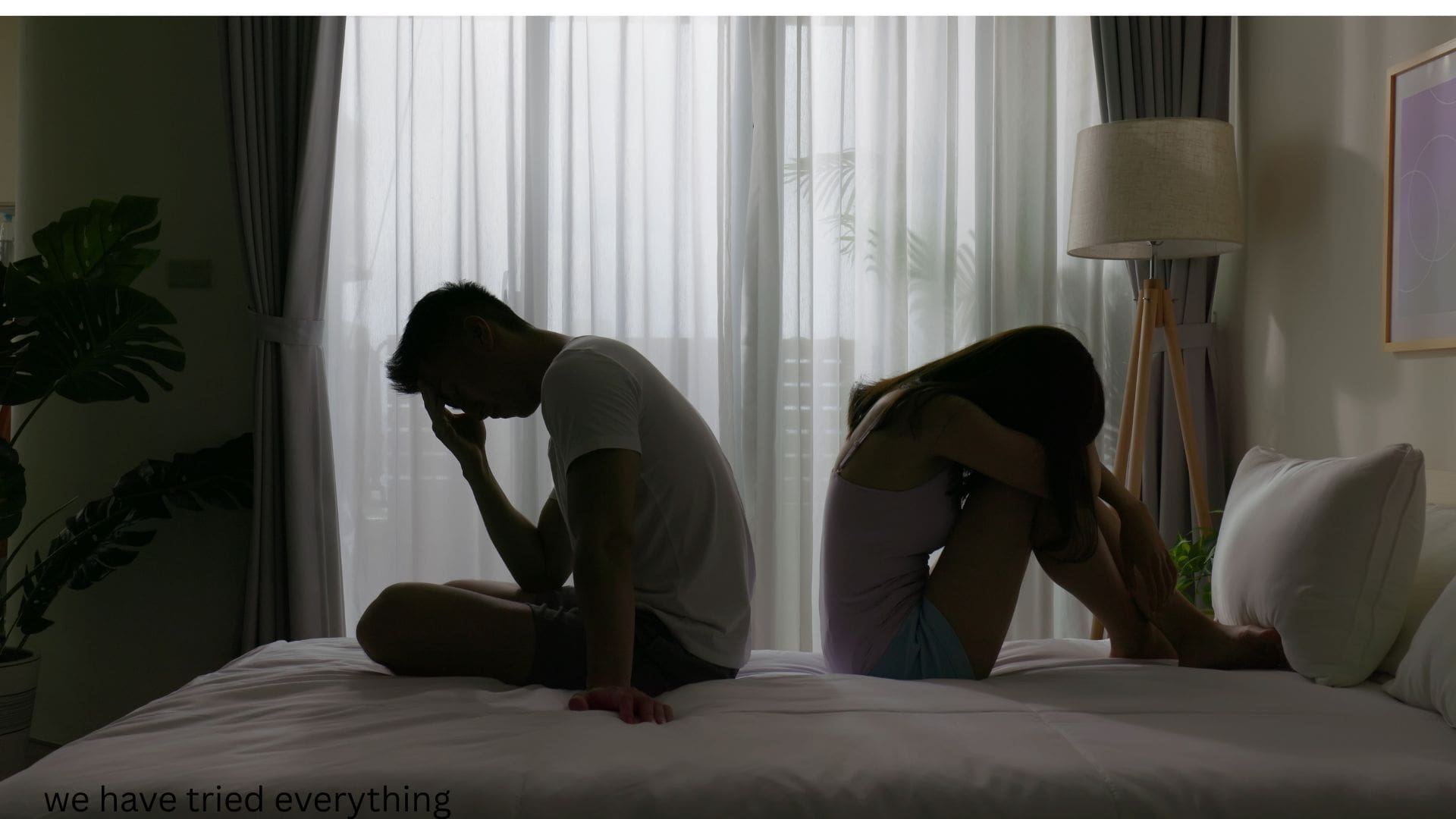
The question I get asked most often about couples counseling isn’t “does it work?” It’s some version of “is our situation the kind it works for?” People imagine there’s a line, and once you cross it, you’re past the point where a therapist can do much besides referee the divorce. That line doesn’t exist the way people think it does. What actually determines whether couples counseling helps has very little to do with how bad things have gotten, and almost everything to do with something quieter.
Almost every couple who calls me says the same thing in the first few minutes. We’ve tried everything. What that usually means is they’ve tried the same thing over and over, the same fight, the same apology that doesn’t land, the same shutdown, on a loop. That’s not trying different things and failing. It’s a hamster wheel, and running harder on it just produces more exhaustion and more proof for each partner that the other one is the problem. What keeps the wheel turning is that it isn’t really two people taking turns causing and reacting, it’s one loop they’re both inside at the same time, each one’s way of coping quietly feeding the other’s. Asking whose fault it is misses the point, because the loop belongs to both of them now regardless of who started it years ago. Two people that deep inside their own pattern usually cannot see its shape from where they’re standing, which is the actual case for bringing in someone from outside it.
Here is what I watch for in a first session, because it tells me more than the presenting complaint does. Is each person willing to be looked at, or did they come in only wanting me to confirm what they already believe about the other one? A couple willing, even through gritted teeth, to ask what they might be doing that keeps the loop turning is a couple I can work with, regardless of how ugly the surface conflict looks. A couple that arrived purely to build a case, where every sentence is really addressed to me as a witness, is a much harder room, no matter how mild their complaints sound.
Two signals matter more than people expect. First, tone. Frustration and real anger are part of any long relationship. Something closer to contempt, an eye roll, a flat mockery, a settled disdain, is a different and more serious signal than anger, and it tends to matter more than whatever they’re actually arguing about that day. Second, not everything a couple fights about is meant to resolve. A fair amount of conflict is really two temperaments or two needs that were never going to line up perfectly, and pretending that can be solved once and for all just sets a couple up to relitigate it forever. The goal there is learning to hold a real difference without it becoming proof, every time it resurfaces, that the marriage is failing.
Two things are exceptions to everything above, not harder versions of it. Active abuse and a fresh betrayal, an affair, a hidden addiction, a secret deception, are not ordinary relationship conflict. Both put one partner into something closer to a trauma response than a communication problem, and a therapist who treats either one like a regular disagreement, taking turns, validating both sides equally, does real damage. That work needs its own course, safety and accountability first, before anything that looks like standard couples repair. It’s a different appointment, not a harder version of this one, and any couples therapist worth seeing should say so plainly rather than proceeding as if two people in the room have equal footing.
What actually happens in the room, when none of those exceptions apply and it’s working, looks less dramatic than people expect. It’s not two people yelling while a therapist referees. It’s slowing the loop down enough that both people can finally see what it’s made of, often for the first time in years, and learning to turn toward each other in the small daily moments that quietly built the distance in the first place. Its learning to see a different point of view, a shift of perspective.
Couples counseling doesn’t save every relationship, and it shouldn’t try to. What it does, for the couples actually ready to be looked at rather than just heard, is give them back the ability to hear each other underneath all the defending.

Comments +